Kintsugi – Breakup Recovery App
Client
Academic Capstone Project
Role
Product Designer & UX Researcher
Year
2025
Deliverables
Mobile App Prototype, UX Research Documentation, Design System, Usability Testing Reports, Presentation Materials
Breakups are no longer purely emotional experiences. They are deeply digital. Persistent photos, shared accounts, social media algorithms, and constant reminders embedded in everyday technology shape the modern heartbreak experience. While therapy platforms and wellness apps exist, few products specifically address the liminal state of heartbreak: the period where people aren't ready to "move on," but desperately want to feel whole again.
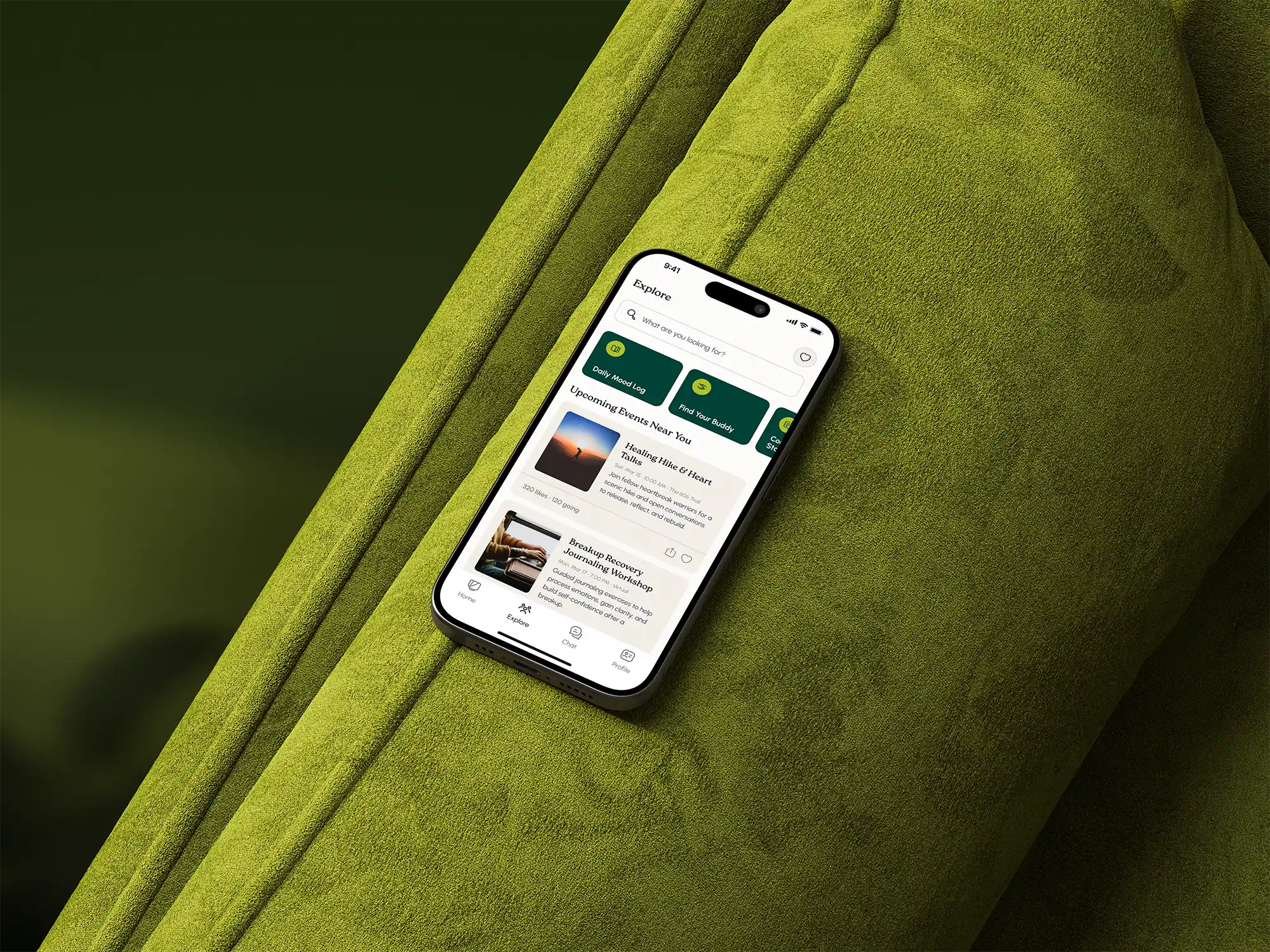
Kintsugi is a conceptual mobile application inspired by the Japanese art of repairing broken pottery with gold. Rather than hiding fractures, Kintsugi embraces them, treating healing as a visible and intentional process. The product guides users through emotional acknowledgment, identity rebuilding, and forward movement without forcing timelines, avoidance, or toxic positivity.
This project explored how product design, behavioral science, and empathetic UX can support emotional healing while respecting user autonomy and privacy.
The Problem
Through early exploration, we identified three compounding factors that make modern breakups uniquely difficult.
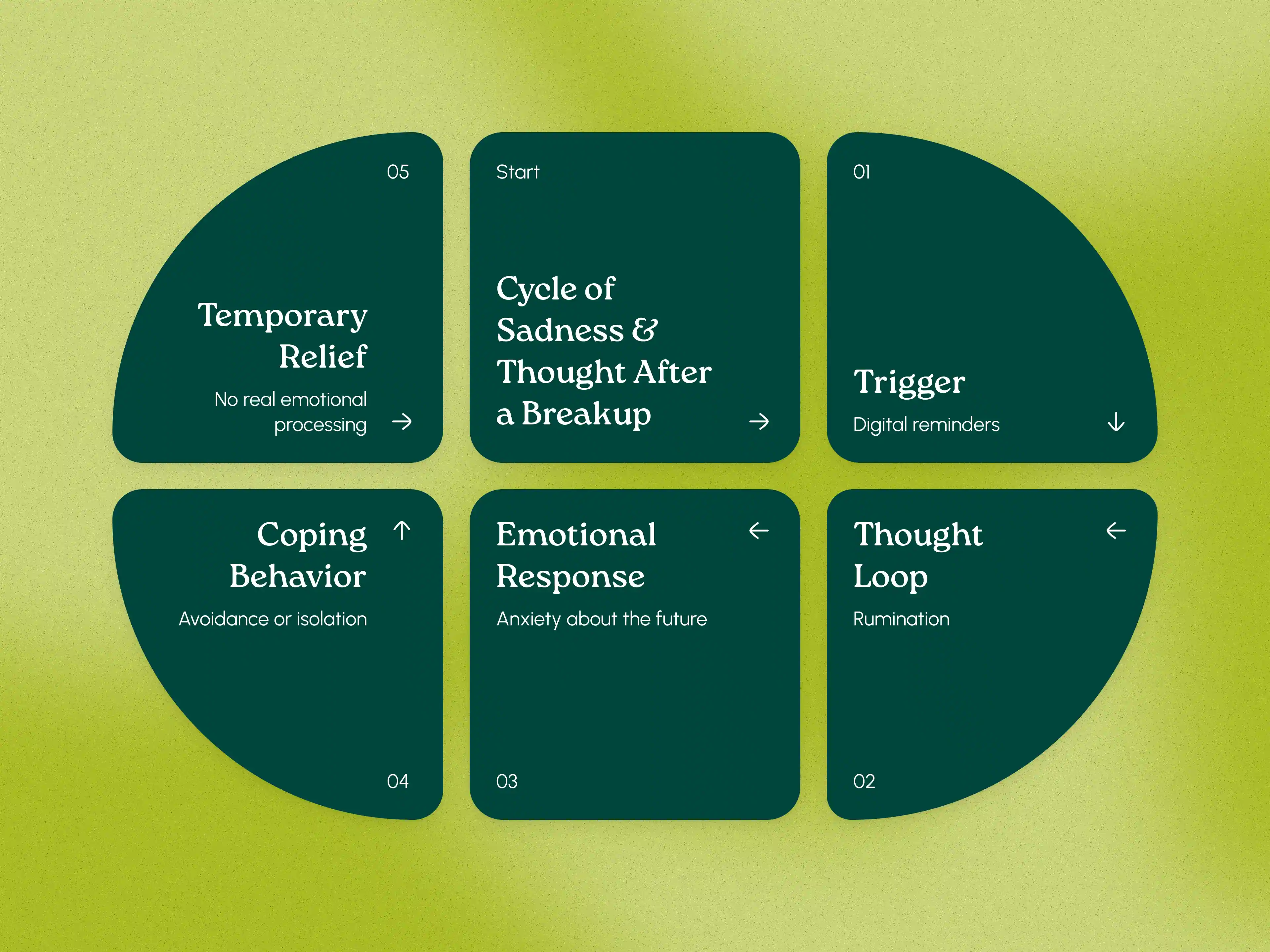
Digital memories are persistent and inescapable. Photos, message histories, shared subscriptions, and cloud storage constantly resurface reminders of past relationships, often without the user's consent.
Social media unintentionally prolongs emotional attachment. Algorithms resurface old content, expose users to their ex's lives, and create pressure to publicly perform "being okay," even when healing remains incomplete.
Existing solutions fail to address this specific vulnerability. Therapy platforms can be expensive and commitment-heavy, while self-care and breakup apps often emphasize distraction or rapid forward motion rather than deep emotional processing.
The result? A gap between emotional need and available tools, one that leaves users stuck, overwhelmed, and unsure how to heal intentionally.


User Context
To ground the work, we centered the experience around a primary persona: Alex, a 28-year-old navigating the end of a long-term relationship. Alex feels disoriented and emotionally exhausted, caught between wanting closure and not knowing how to move forward. Digital reminders amplify this uncertainty, while social pressure discourages vulnerability.
Alex doesn't want judgment, forced positivity, or a rigid recovery plan. What Alex needs is a private, supportive space that adapts to emotional readiness and respects personal boundaries. This persona guided our tone, interaction patterns, and product decisions throughout the project.

Research & Discovery
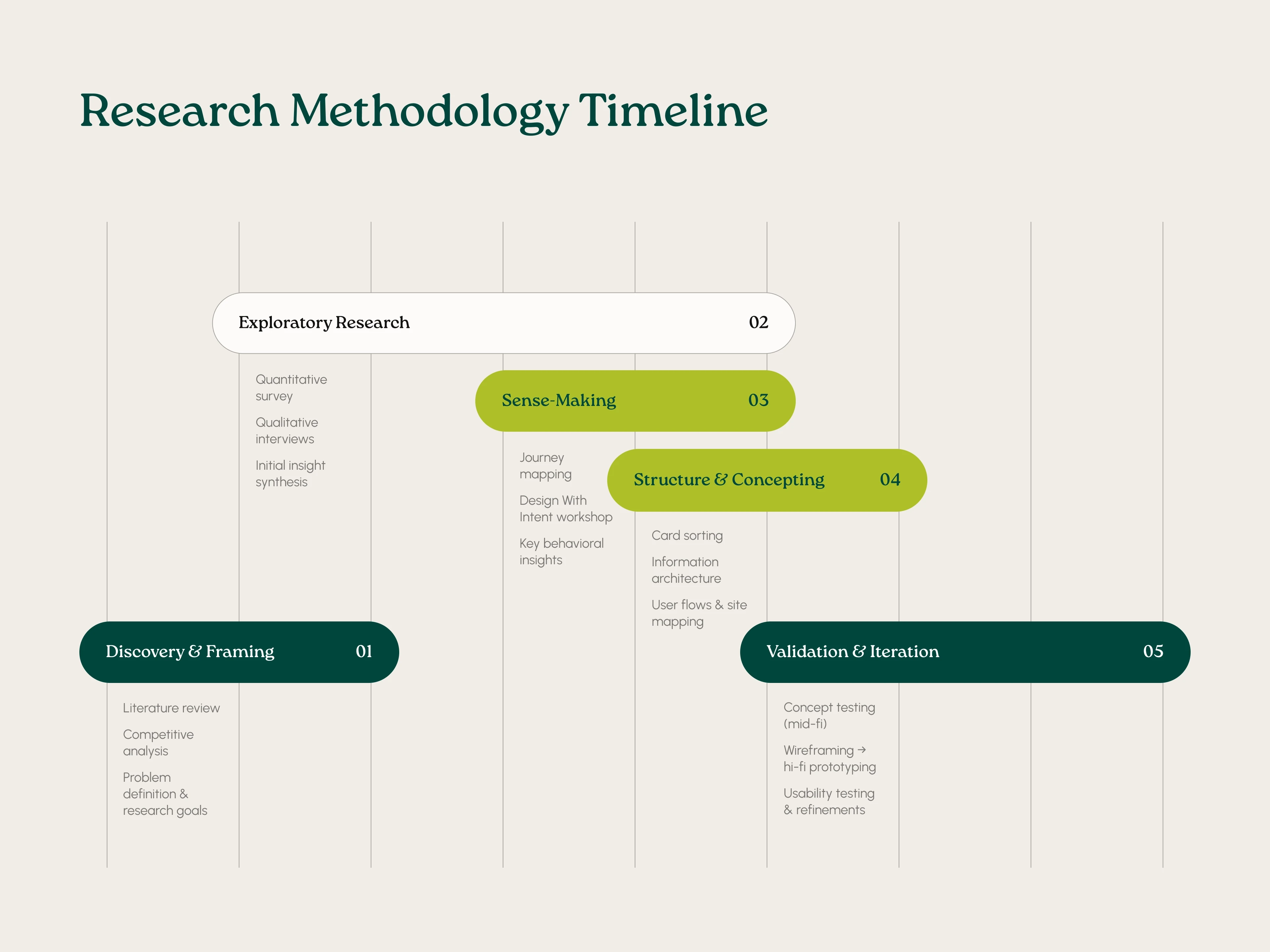
This project was grounded in rigorous qualitative and quantitative research. We began with a literature review spanning psychology, digital identity management, breakup recovery, and behavioral science. These findings were reinforced through competitive analysis of platforms such as BetterHelp, Replika, and Breakup Boss, which revealed a lack of breakup-specific, self-directed healing tools.
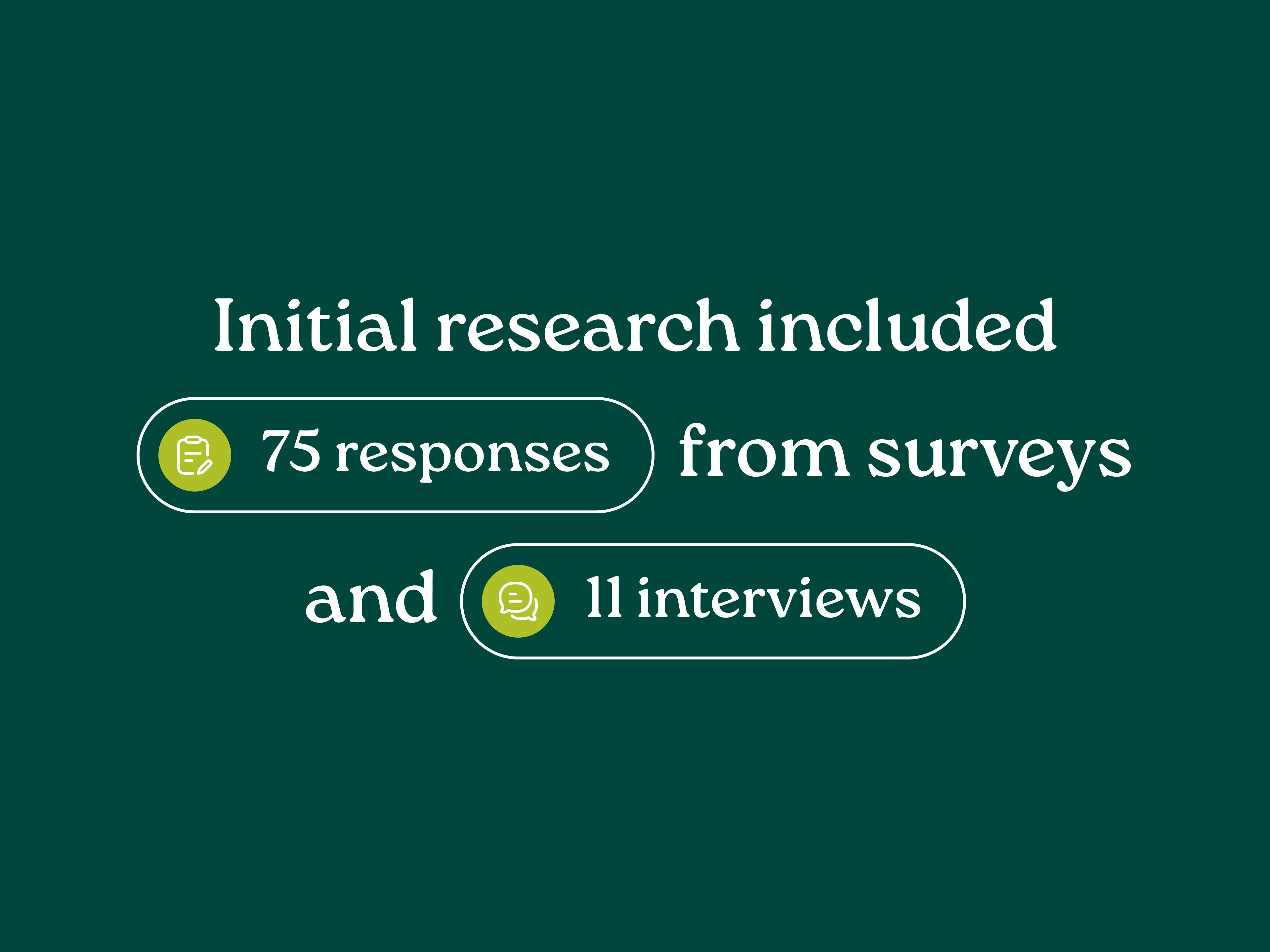
We conducted surveys with 75 participants and in-depth interviews with 11 individuals who had experienced recent romantic or platonic breakups. Many participants expressed hesitation around discussing heartbreak openly, highlighting the need for privacy, emotional safety, and non-intrusive design.
To deepen understanding, we mapped the breakup journey across multiple emotional phases and conducted a Design With Intent workshop to explore how product design could promote healthy behaviors while discouraging harmful ones. Card sorting and preference testing further informed information architecture and feature prioritization.
Key Insights
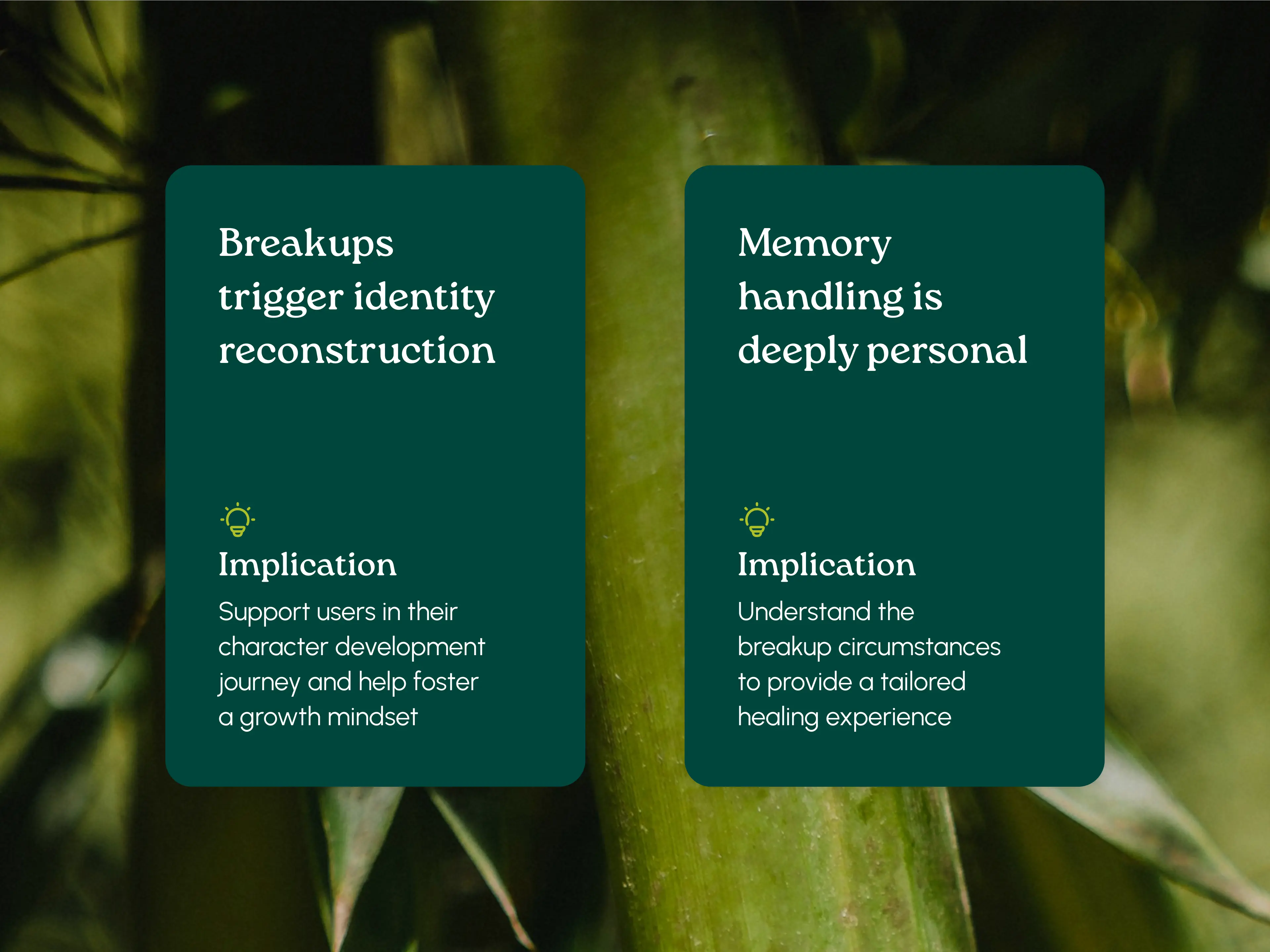
Breakups trigger identity reconstruction. Participants described heartbreak not only as loss, but as a moment of self-redefinition. This reframed the product goal from emotional relief to long-term growth.
Memory handling is deeply personal. Some users wanted complete erasure of reminders, while others preferred to preserve memories safely. Breakup circumstances strongly influenced these preferences, making one-size-fits-all solutions inappropriate.
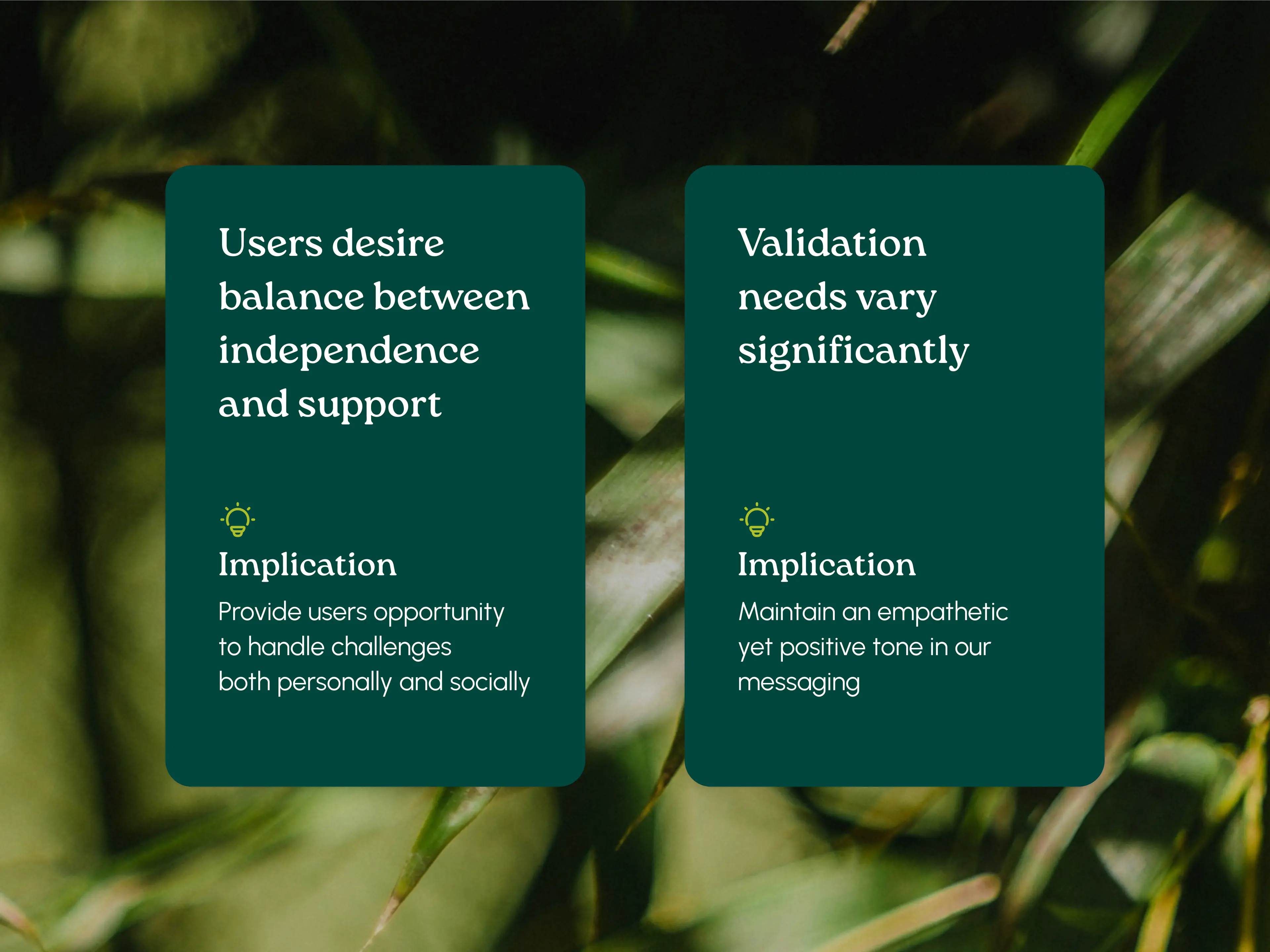
Users desire balance between independence and support. They wanted tools for private reflection, but also optional connection with others who understood their experience.
Validation needs vary significantly. Some wanted reassurance, while others found overt validation uncomfortable. This insight shaped a neutral, empathetic tone that avoids assumptions about emotional needs.
Journey Mapping
We mapped the breakup experience across five phases: intrapsychic, dyadic, social, resurrection, and new beginnings. Each phase revealed distinct emotional states, behaviors, and opportunities for intervention.
This framework helped us identify when users needed structure versus flexibility, guidance versus space, and reflection versus action. Rather than forcing linear progression, Kintsugi supports movement between phases at the user's own pace.


Solution Strategy
Kintsugi was designed as a guided yet flexible healing experience. Instead of prescribing a rigid recovery path, the app adapts to the user's emotional state and preferences, offering tools for reflection, growth, and optional peer support.
Core elements include:
Guided onboarding to understand breakup context
Reflective prompts and emotional check-ins
Buddy Program for peer-level support
Growth-oriented activities that encourage rebuilding identity and confidence
The product emphasizes autonomy, emotional safety, and intentional progress.

Information Architecture & Flows
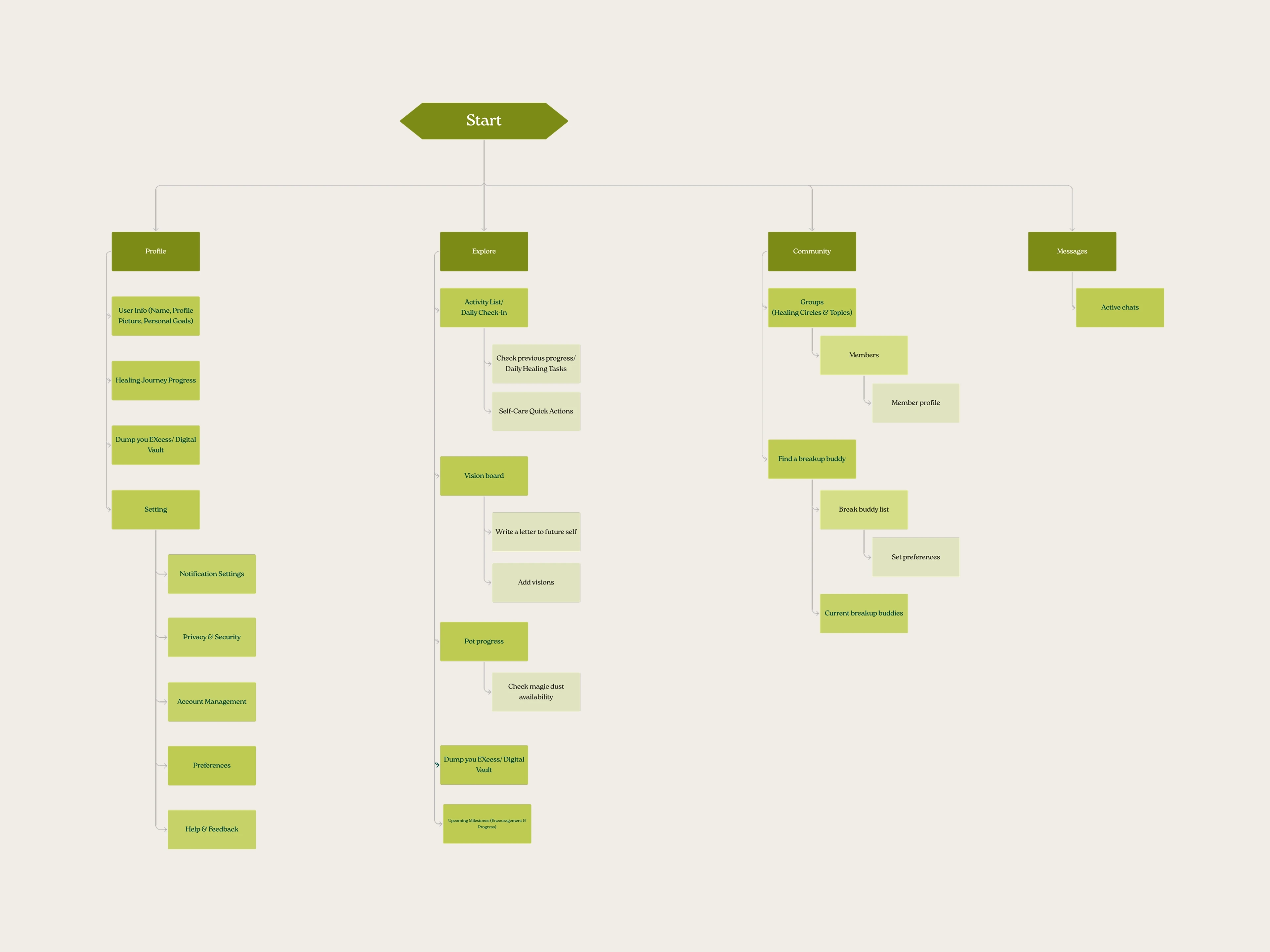
Card sorting revealed that users naturally grouped features around growth, community, digital wellbeing, and routine. Confusing categories were simplified to align with user mental models.
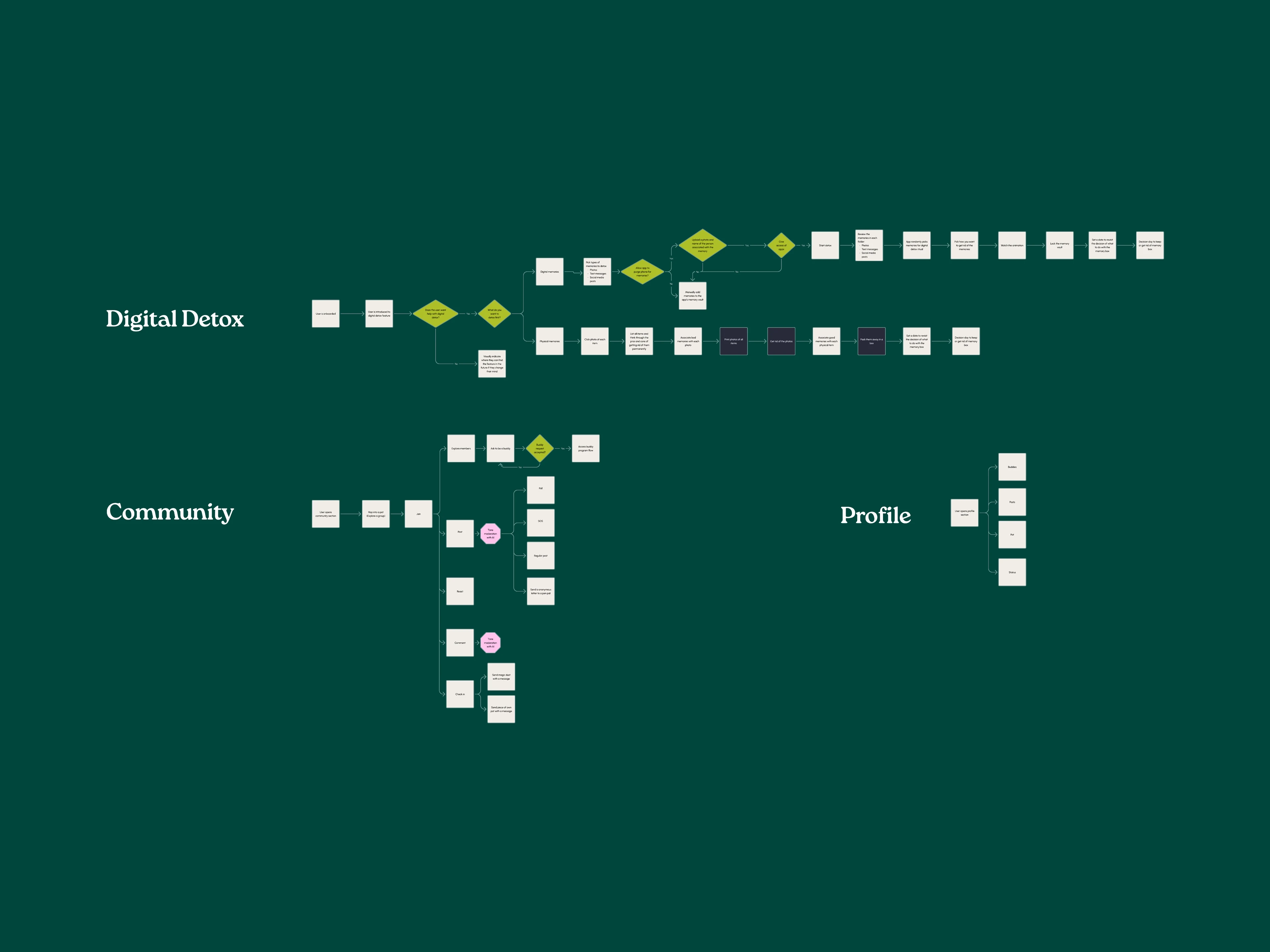
The final navigation prioritized clarity and emotional ease, with four primary areas: Home, Explore & Community, Messages, and Profile. Key user flows included onboarding, finding a buddy, and engaging with reflective activities.

Design With Intent
Using behavioral science principles, we intentionally designed features that promote healthy behaviors such as self-reflection, social reconnection, and identity rebuilding while discouraging rumination, impulsive memory deletion, and negative self-talk. The Design With Intent workshop generated 35 distinct solutions organized around eight behavioral lenses, including error proofing, interaction, ludic, and cognitive approaches.
The interface emphasizes calm visuals, clear choices, and user control, ensuring interactions feel supportive rather than prescriptive. Key design decisions included implementing a Kintsugi pot interaction as a visual progress metaphor, using gamified elements to maintain motivation without trivializing the healing process, and incorporating breath work and mini videos on handling difficult emotions.
Each feature was mapped across the breakup journey phases to ensure interventions aligned with users' emotional readiness. Digital cleanup tools appear during the social phase when users are ready to manage their online presence, while identity reconstruction activities emerge during the resurrection phase when users begin envisioning their future selves.


Prototyping & Iteration
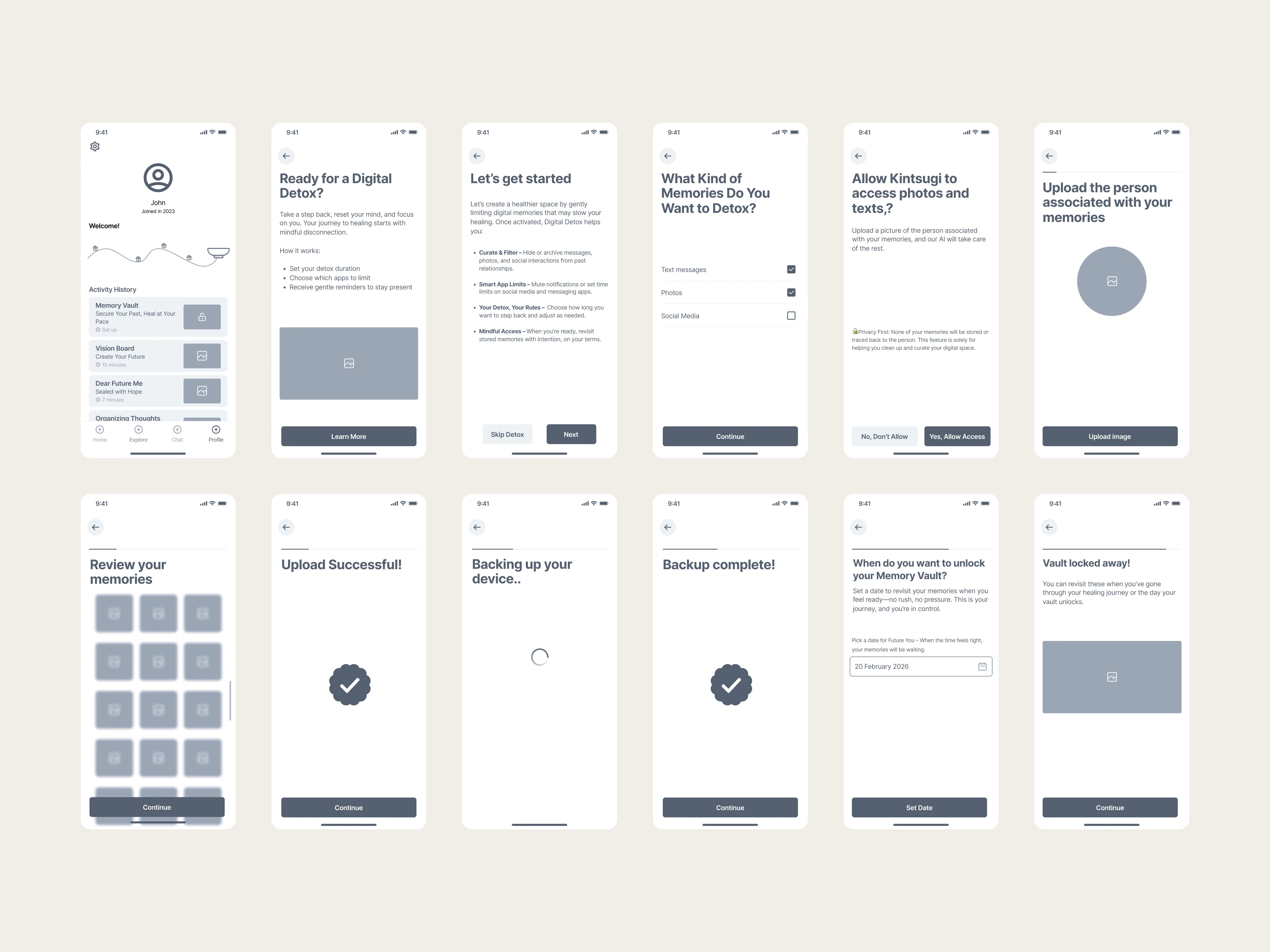
Mid-fidelity concept testing revealed strong foundational usability but highlighted the need for more empathetic language and clearer action cues. Importantly, testing surfaced significant concerns around a proposed Digital Detox feature, particularly related to data privacy and control.
Rather than forcing a feature users didn't trust, we made the deliberate decision to remove it. This choice reinforced an ethical, user-first approach and demonstrated restraint in feature prioritization.
High-fidelity prototyping focused on refining tone, interaction clarity, and visual consistency. A symbolic Kintsugi animation reinforced the emotional metaphor of healing.
Usability testing showed significant improvement:
System Usability Score increased from 67.5 to 88.75
Participants described the app as calm, intuitive, and emotionally supportive

Outcome & Impact
Kintsugi demonstrates how thoughtful product design can support emotionally complex experiences without overstepping user boundaries. The final prototype achieved a System Usability Score of 88.75, well above the industry standard of 68, and a Net Promoter Score of 60, indicating users would actively recommend the app to others. Participants consistently praised the app's calming interface, cohesive visual identity, and empathetic tone, with the Kintsugi animation emerging as a particularly powerful moment that helped users embrace the healing philosophy.
The project also demonstrated mature design judgment through feature restraint. By removing the Digital Detox feature despite initial investment, we prioritized user trust and autonomy over feature completeness. This decision reinforced that ethical design sometimes means knowing when not to build something, even when it seems valuable from a design perspective.
Looking forward, Kintsugi presents multiple expansion opportunities including AI-driven mentorship matching, dynamic healing roadmaps that adapt in real time to emotional states, and expert-led therapy workshops. Social impact initiatives, such as peer mentorship programs where healed users support newcomers, could foster long-term community engagement and sustainable healing ecosystems.


Reflection
This project reinforced that product design cannot solve emotions, but it can create space for people to heal themselves. One of the most valuable lessons emerged from understanding that healing is deeply nonlinear and highly personal. Our initial instinct was to create a structured recovery plan, but research revealed users needed adaptability over prescription. This tension between structure and flexibility became a defining characteristic of the product, teaching us that the best support systems accommodate diverse approaches to healing.
The journey also highlighted the emotional weight of digital traces in modern relationships. We initially believed the Digital Detox feature would be universally helpful, but user feedback revealed that memory management is intensely personal and situationally dependent. The Buddy Program offered unexpected insights too, showing that users valued communication styles and availability more than shared experiences, revealing that effective support depends on compatible interaction patterns rather than identical circumstances.
Ultimately, Kintsugi represents more than an app design. It embodies a philosophy that technology should enhance human resilience without replacing human connection. By embedding empathy into every interaction and respecting user autonomy at every decision point, we created a meaningful step toward redefining digital wellness tools for emotionally complex experiences.